
The Body Knows First
Notes From Trekking the Gobi Desert
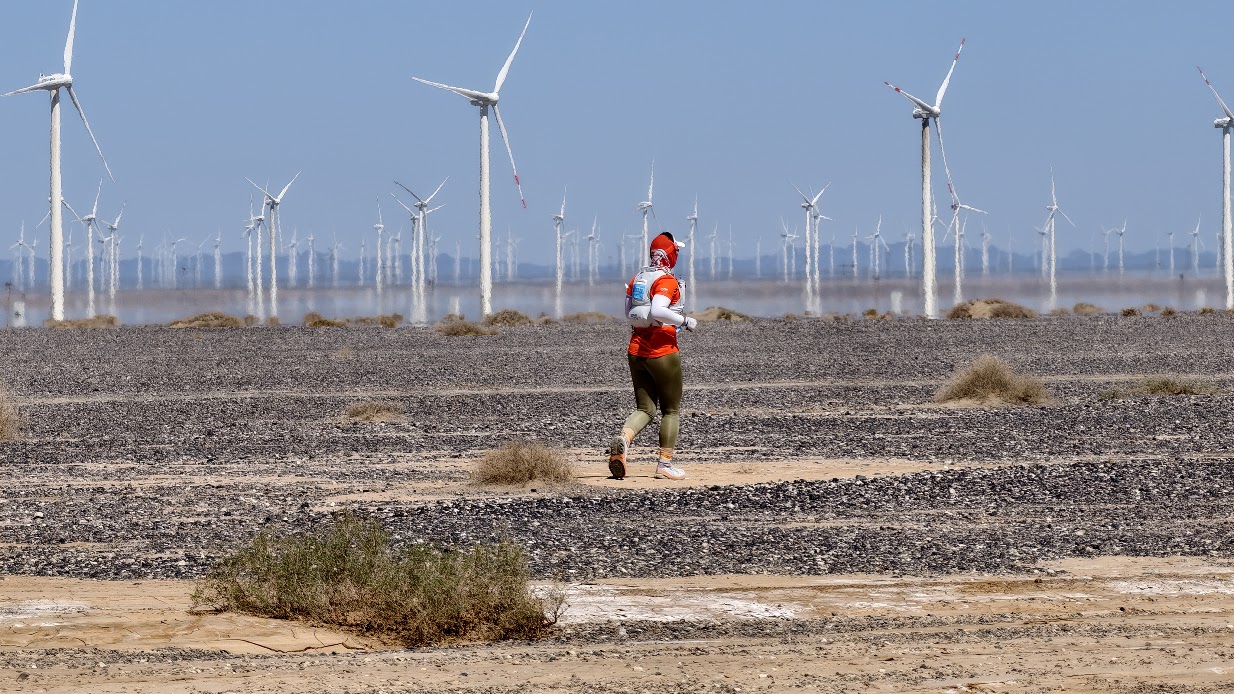
"Once we acknowledge that cognition is a situated activity growing out of a tangled dance of body, mind, activity, and world . . . you have the building blocks for a flesh-and-blood sociology..." —Loïc Wacquant (2015, p. 4)
Gobi Desert, West of Gansu, China.
May 2nd. 5:30 in the morning. Most people were still sleeping since it was a public holiday.
Six degrees Celsius. I woke up in a jacket, the only "warmer" piece of clothing that I was even hesitant to bring along initially. I lost sleep the entire night because my sleeping bag was too light and thin. Cold, drowsy, dizzy. I struggled over whether I could and should continue the 20-kilometer trek today. My body was telling me something, or perhaps it was my mind?
***
In 2019, Professor Mark de Rond and colleagues published a paper in the Academy of Management Journal titled "Sensemaking from the Body." He and two companions spent three weeks rowing the full navigable length of the Amazon—2,100 miles from Peru to Brazil. Not for the adventure, but to answer a research question: how does the body participate in sensemaking? How do we come to understand our situation through the body, not just through the mind?
The authors draw a distinction between two analytical modes. One is sensemaking of the body — observing bodies from the outside, coding video footage, analyzing gesture and posture from a researcher's remove. The other is sensemaking from the body — first person, fully immersed, letting your own flesh and nerves report what they're encountering.
Most organizational research does the first. The second requires us to actually get in the water.
***
In the Gobi, I was doing the second.
Not because I had planned it that way. But because the people I was studying—the entrepreneurs and executives who had chosen to trek this desert—were doing something that couldn't be explained by existing theories. To understand why they volitionally "pay to suffer," I had to walk with them, trek with them, and live with them. Same gravel underfoot, same wind in the face, same weight on the shoulders.
***
The first day of trek.
At kilometer 11.8, a sandstorm hit.
The wind came head-on. "A few gusts," I wrote in my field notes, "felt like a full-body sand shower. I could literally feel sand in my mouth." The desert entered me. And it was in that moment, the moment I tasted grit on my tongue, that I understood I was really doing fieldwork.
At kilometer 14, there was a supply station.
A makeshift shelter in the middle of the storm. Crates of tomatoes, cucumbers, salted peanuts. The trekkers who had arrived — people who, back in Shanghai or Beijing, attend business dinners with neatly folded napkins and curated wine lists — were grabbing tomatoes with bare, sand-dried hands and biting straight in.
"These tomatoes taste incredible."
The tomatoes were ordinary looking, the kind one would walk past at any supermarket. But here, after 14 kilometers of wind and exhaustion, that juicy fruit produced something close to euphoria.
De Rond and colleagues describe a parallel moment on the Amazon. As fear and physical depletion accumulated day after day, the rowers' perception of their environment was fundamentally altered. The body's "sentience" — its capacity to feel pleasure and pain — became central to how they navigated forward. Physical deprivation rewrites what counts as good.
Standing there in the sandstorm, I didn't reach for my notebook. I reached for a tomato. Ate it. That, too, was data.
At kilometer 15.3, I was "picked up" by one of the business school teams while I was trekking alone. They told me it didn't appear safe to trek solo. They then started running. I ran too, but soon my breathing accelerated beyond what I could sustain. My lungs sent the message before my brain formulated a thought: this is not my speed.
I slowed down and let them go ahead.
The decision wasn't made in my head. My body made it. And that decision directly shaped the next several hours of my research — because slowing down gave me the capacity to observe, to write, to eventually reach what I described in my notes as a state of "mindful walking": all attention concentrated in each step, the chatter gone quiet, the field suddenly legible.
My research method was determined by my body.
***
De Rond and colleagues call this enactive ethnography. The researcher doesn't stand beside the phenomenon and observe it but performs it. The self becomes the primary instrument of understanding.
The French sociologist Loïc Wacquant spent years training in a Chicago boxing gym to study pugilism from the inside. The American sociologist Matthew Desmond became a wildland firefighter in northern Arizona to study fire crews. They weren't simulating experience. They were letting the logic of the field sediment into their bodies—what Wacquant calls sedimentation, the accumulated deposits of a life lived in a particular way.
I walked the Gobi because the entrepreneurs who come here are using their bodies to test something. If I didn't bring my own body to the same test, I couldn't fully understand what they were testing, or why, or what they found.
***
But I'm also an entrepreneur.
Entrepreneurship is a bodily experience. This is something we rarely say clearly.
We talk about entrepreneurship in terms of strategy, business models, fundraising, growth. But anyone who has actually done it knows that the most real parts happen in the body. The gut-sense that something is off before we can articulate why. The fatigue of running on uncertainty for months. The particular clarity of an insight when everything else has gone quiet.
The field&flux platform exists, in part, because I want to put those experiences in conversation: the enactive ethnographer's way of knowing, and the embodied knowledge of entrepreneuring. I felt their resonance across those kilometers of the Gobi. I'm still working out what it means.
***
If you're curious about entrepreneurship, ethnographic fieldwork, or what happens when you try to do both at once, welcome to field&flux.
Professors Mark de Rond, Isaac Holeman, Jennifer Howard-Grenville: thank you for the framework. I've been finding traces of the Amazon in my Gobi ever since.
Reference
De Rond, M., Holeman, I., & Howard-Grenville, J. (2019). Sensemaking from the Body: An Enactive Ethnography of Rowing the Amazon. Academy of Management Journal, 62(6), 1961–1988.
Wacquant, L. (2015). For a sociology of flesh and blood. Qualitative sociology, 38(1), 1-11.
Comments
Leave a comment
Comments are moderated and will appear after approval.